Partner Misalignment: How to Stop Building the Same Business in Different Heads
Co-founders can run the same business for years with fundamentally different ideas of where it's going. A three-step partner synchronization session framework — how to surface misalignment, work through personal ambitions, and reach a shared strategy before the gap becomes a conflict.

Sergei Andriiashkin
Founder and Strategy Partner
Strategy
/
Mar 16, 2026

Most conflicts between co-founders don't start with betrayal or greed. They start with partners losing a shared understanding of reality — and continuing to build the same company, each inside their own version of it.
One thinks last year was a breakthrough. The other thinks it was a failure. One sees the company in three years as a technology platform. The other sees a network of physical locations. One expects the partner to stay focused on operations. The other switched to strategy long ago and assumes this is obvious. None of this feels like conflict — until the accumulated divergence starts blocking decisions, demotivating the team, and slowing growth.
This is what partner misalignment looks like. And the tool I use to address it is a partner synchronization session.
Why a standard strategy session won't help here
A strategy session is a valuable tool — but it's built for a different purpose. It works with the team: aligning goals, distributing priorities, forming a plan. It assumes that the owners have already agreed between themselves and are cascading a unified direction downward.
If they haven't, running a strategy session with the team in the presence of misaligned co-founders means making the divergence public — spreading uncertainty to people who need clarity, and signaling to the team that the leaders themselves don't know where they're going.
A partner session is a closed format: co-owners only, plus an external facilitator. The goal is to create a structured space where each partner can honestly capture their own view — and compare it with the others' without immediate confrontation.
The key difference: misalignments don't surface through argument — they become visible on the board. When three people answer the same set of questions about where the business is heading, the differences in their answers speak for themselves. This reduces emotional tension and shifts the conversation from "who's right" to "what are we actually building."
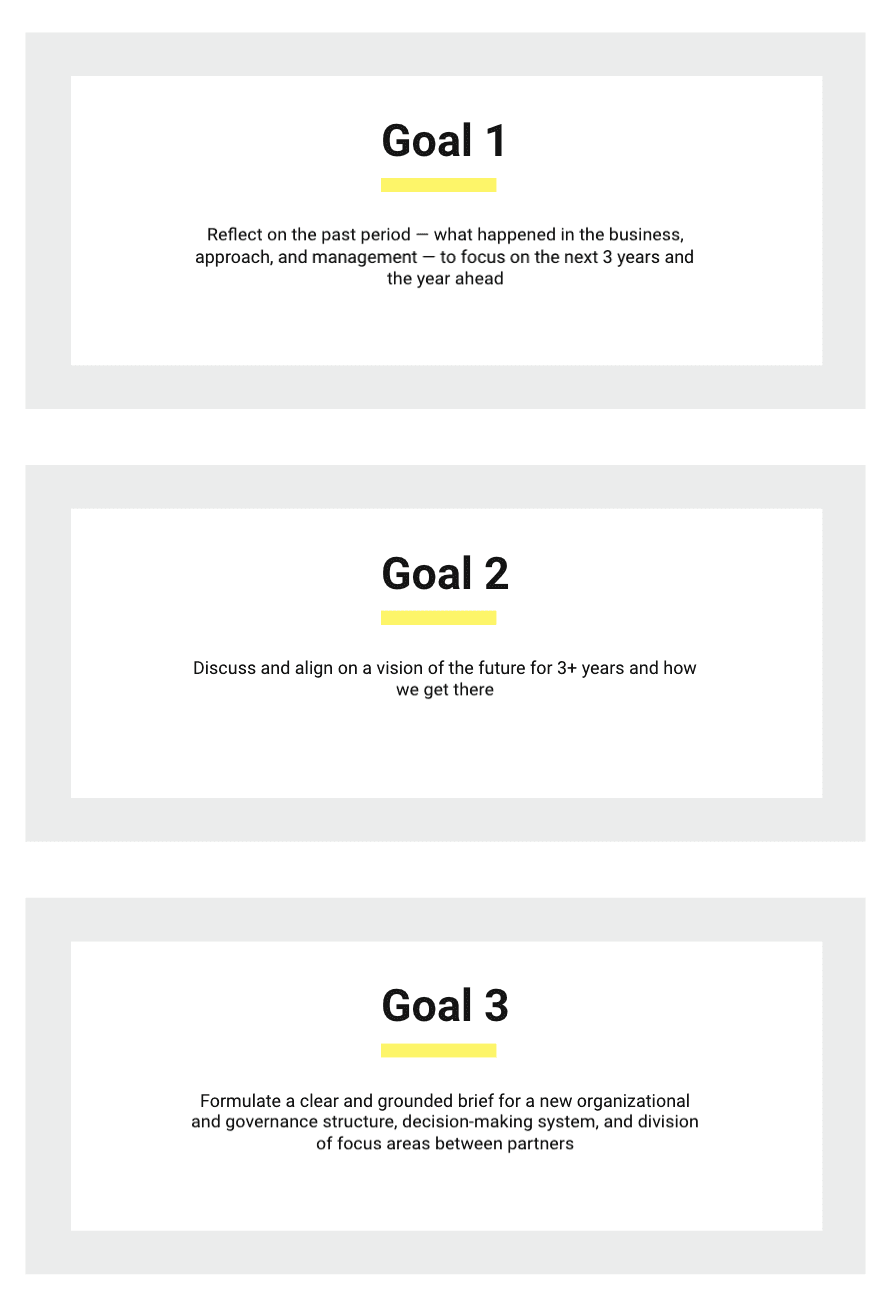
The three-step partner session framework
Step 1. Retrospective: everyone has their own version of the past
Before aligning on the future, partners need to synchronize on what actually happened. This sounds obvious — but in practice, two or three people who've been running a business together for years can hold fundamentally different versions of the same events. One thinks the main problem last year was the team. Another is certain it was processes. A third thinks the year went fine. Building future alignment on top of unresolved differences in how you read the past means building on unstable ground.
The retrospective block uses Stop / Start / Continue — a standard retrospective framework. The value isn't in the questions themselves, but in the choice of analytical dimensions they're applied to:
Role distribution and partner interaction — who is actually responsible for what, how decisions get made, where accountability is blurred or overlapping
Strategic bets of the year — which key decisions were made, did they work, what proved right and what didn't
Team — how people were managed: hiring, development, motivation, personnel decisions
Clients — how relationships with the audience were built, what changed in the customer experience, what worked in acquisition and retention
Processes — how operations were organized, where bottlenecks appeared, what helped and what got in the way
The result is a complete picture of how each partner reads the past year — and that picture often diverges significantly between participants, even on facts, let alone on interpretation.
Mechanics matter: it's better to start with individual work — often several hours of thinking done separately before the session. This is a condition for honesty: when someone sees the others' answers before recording their own, they inevitably start adjusting.
Once all versions are on the board, discussion begins: observations are grouped, patterns emerge. From there, the goal is to move directly to specific decisions. What exactly are we changing? Who owns it? By when? The output is a concrete action plan with owners and dates. Clustered observations then become the input for the second block — ambition alignment.
Step 2. Ambition alignment: the person first, the partner second
The typical mistake when trying to align strategic vision is to start with the company. Where are we going? What's our three-year goal? What are we building?
But corporate strategy doesn't exist in a vacuum. What a person does in a business always has roots in personal ambitions and circumstances. If that foundation isn't made explicit, any strategic discussion risks stalling — or landing on formal agreement that conceals fundamentally different motivations.
So each participant starts by answering questions about themselves — separate from the business, their role, and their obligations:
Why am I doing this at all? What drives me?
What am I building — for myself, not for the company?
What do I want to achieve in the next 3–5 years — as a person, not as a partner?
How do I measure success? Money, influence, freedom, impact — what actually matters to me?
How do I work — what values guide me, what kind of processes do I build?
This isn't coaching or therapy. It's a strategic tool. One partner wants to exit operations in five years and become an investor. Another wants to build a market leader and stay as CEO. A third wants to monetize accumulated expertise through new ventures. Without this understanding, strategic decisions get made under a layer of hidden conflicts of interest that no one names out loud. One session revealed a significant gap between the founder and the other partners — it was each person's personal ambitions that made clear where the gap came from and why it wasn't resolving through ordinary working conversations.
As in the retrospective, answers are grouped across the five questions — looking for points of overlap and divergence between participants.
Once personal ambitions are captured and shared, the conversation shifts to the company — with a noticeably different quality of honesty. The joint work on the strategic frame covers seven blocks:
Strategic goals and vision for 3 years. The primary planning cycle is three years, though the discussion can extend to five. Key questions: how will we know we've achieved what we wanted? What metrics, what thresholds? What will the whole team be working toward during this period? In the course of this conversation, what emerges isn't just goals — but what I call quantum leaps: the most significant changes that need to happen in the business. Goals are captured in OKR format, which frames them as changes, not states.
Context and trends. What's happening in the industry and with the audience? PEST analysis works well as a framework here. This block benefits from preparation in advance: a deep analysis can be pulled from memory when you're close to the topic, but taking additional time to do it rigorously produces better input.
Goals for the coming year — overall and by business unit or product.
Key changes. What shifts need to happen in the business over the next year, and why? How will we know they've occurred?
Key projects. Which projects need to be delivered in the coming year? Top-level only — no deep dives here.
Core value proposition. What is the value of this business and team — for clients, partners, the market?
Expectations of each other. One of the sharpest, and most productive, conversations. Each partner articulates what they need from the others — specifically, in the context of the future they've described. Not "I want more involvement," but "I want you to lead this project as an owner." This is a conversation that almost never happens in the normal flow of work — which is exactly why expectations accumulate and become a source of tension.
When reflection and ambition are brought into the open, things that have been silently shaping the working dynamic tend to surface. In a group of three to five people with a shared board, it becomes clear who is formulating and spreading a vision, who is following it — and who is quietly resisting it.
Step 3. Architecture: structure that fits the agreed vision
The third block follows directly from the second. Once partners have agreed on where they're going, the next question is: how is the company organized to get there? Does the current structure and governance model match the vision that was just aligned?
The work moves through six directions — sequentially, from diagnosis to action.
1. The problem. What isn't working in the current structure: where accountability is unclear, where functions are duplicated, where decisions stall. Retrospective cards from Step 1 feed directly into this — they already contain the relevant observations.
2. Context and vision. The structure is examined not in the abstract, but in relation to what was agreed in Step 2: the shared vision, the strategic bets, the quantum leaps that need to happen.
3. Key changes. What does the new structure need to be able to do that the current one can't? Functions that need to be created, decisions that need to shift to different levels, duplications that need to be removed.
4. Hypotheses. Concrete assumptions about what needs to change in governance, partner roles, and team structure. Not final decisions — but captured and prioritized.
5. The current core team. Who's in place, what competencies are covered, where the gaps are. And a separate question: what is the key competence of each partner, and what contribution is each making toward the future of the company. This conversation is often the most honest one in the entire session.
6. Next steps. What are we doing, who owns it, by when — as a direct output of the third block.
The goal here isn't to design a new organizational structure in a single session. That's not realistic. The goal is to formulate a clear and grounded brief: what needs to change, why, on what timeline and with what priorities — based on a concrete analysis of the past, an agreed view of the future, and a real map of the team.
What partners take away
The final artifact of the session isn't just a meeting summary. It's a next steps map with specific tasks, owners, and dates across all three blocks.
A key element of the closing is capturing outcomes in OKR format. The strategic goals partners have aligned on become Objectives — with key results that define how progress will be measured. This isn't administrative overhead: OKRs turn the session's agreements into a working instrument for strategic planning, which then serves as the foundation for team-level goal-setting and transformation management. Partners leave not with a "sense of direction" but with a ready strategic core — one that can be cascaded immediately.
The output map typically includes:
strategic OKRs for one year and three years with agreed metrics;
a prioritized project list with owners;
explicitly stated expectations between partners;
a grounded brief for organizational changes;
specific next steps with deadlines and owners.
Beyond the document: partners leave with a shared language — decisions get made faster, the team receives a clear direction, and disputes over priorities happen less often.
Why an external facilitator matters
In a partner system, every participant is simultaneously a subject of the discussion and part of it. This is a structural problem that's difficult to solve from within: maintaining neutrality toward your own answers, holding a productive frame when the conversation touches personal ambitions — all of this requires a position outside the system.
The external facilitator's role isn't to make decisions for the partners. It's to own the architecture of the conversation: sequence, depth of each block, capture of agreements. And to ensure that what surfaces in the process becomes a concrete plan — not just a shared feeling.
How I work
The partner synchronization session is a one-day format for 2–4 co-owners, in person or hybrid. It's often run as a preparatory step before a company-wide strategy session with the team: partners align between themselves first — then a unified position is carried forward.
Before the session, I conduct individual interviews with each participant to understand the business context, the history of the partnership, and the key pressure points. Sometimes misalignment becomes visible at the diagnostic stage itself. In one case, a partner group held completely different views on an AI and digitization initiative: one saw it as FOMO — "we need to do this because everyone else is" — while another saw it as an operational automation play, with a fundamentally different time horizon and investment logic. On the surface: agreement on direction. Underneath: two different decisions.
If this sounds familiar — reach out. We can talk through whether this format makes sense for your situation.