The World Has Become Nonlinear: Why Strategy No Longer Works as a Plan
The speed of change has nearly tripled over the past few years. Geopolitics, AI, and global instability are reshaping markets faster than organizations can adapt. Why strategy today is no longer a document, but the ability to hold direction in a constantly shifting environment.
Sergei Andriiashkin
Founder and Strategy Partner
World
/
May 21, 2026
The world has not simply become more crisis-prone — it has become nonlinear. I don’t think we fully realize how much the speed of change has accelerated.
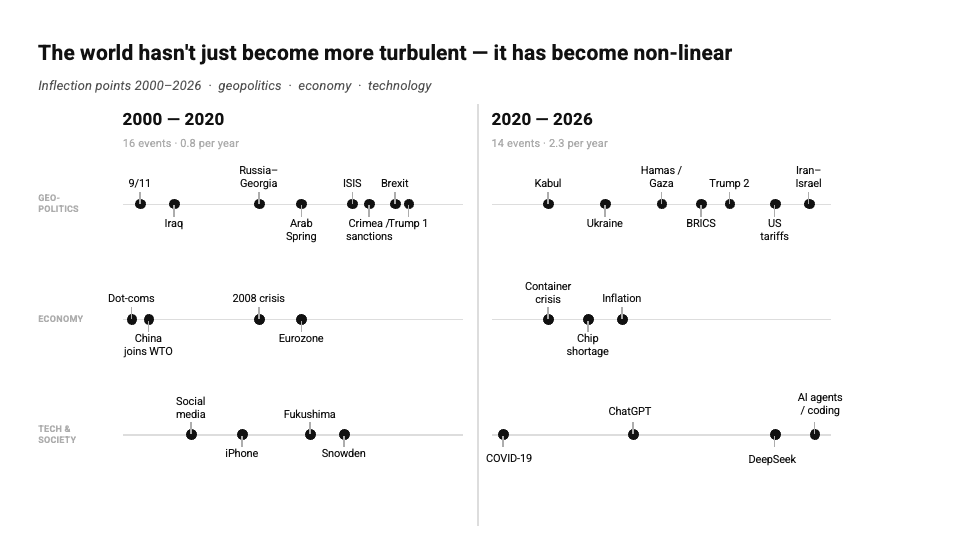
While preparing for a talk at Arabian Marketing Community, I was trying to answer a simple question for myself: is this just a subjective feeling, or has the world actually started moving faster? To explore this, I mapped out the key inflection points of the last 25 years — geopolitics, economics, technology. And the picture turned out to be quite stark: between 2000–2020, the world went through ~0.8 major inflection points per year. From 2020 to 2026, that number jumped to ~2.3. In practice, the speed of change has nearly tripled.
But this is not only about the number of events — the nature of the environment itself has changed. Global instability has become the norm, and technology is reshaping markets and human behavior not over decades, but within months. AI transformed from an experiment into infrastructure in just two years. New rules of the game are emerging faster than organizations can formalize them.
That is why strategy today is no longer a document — or even a “long-term plan.” Strategy is the ability to hold direction while the environment itself keeps moving. The ability to assemble teams, partnerships, tools, and decisions under constantly shifting rules. And perhaps the key capability today is not just helicopter view, but the ability to design your own vision of the future, hold onto it, and build your own game around it.
In a nonlinear world, the winners are not the biggest players — but those who can hold onto their vision of the future while the rules around them continue to change.