How “Unicorn Logic” Breaks in the AI Era — and What This Changes for Investing
How unicorn logic breaks in the AI era: why scale no longer equals headcount, excess capital turns into a liability, and defensibility shifts toward product engineering, data, and operational AI integration. Key takeaways from the Why Unicorn Logic Breaks in AI panel at the Machines Can Think conference in Abu Dhabi — on how AI reshapes investing, startup evaluation, and the role of ecosystems.

Sergei Andriiashkin
Founder and Strategy Partner
AI
/
Feb 6, 2026
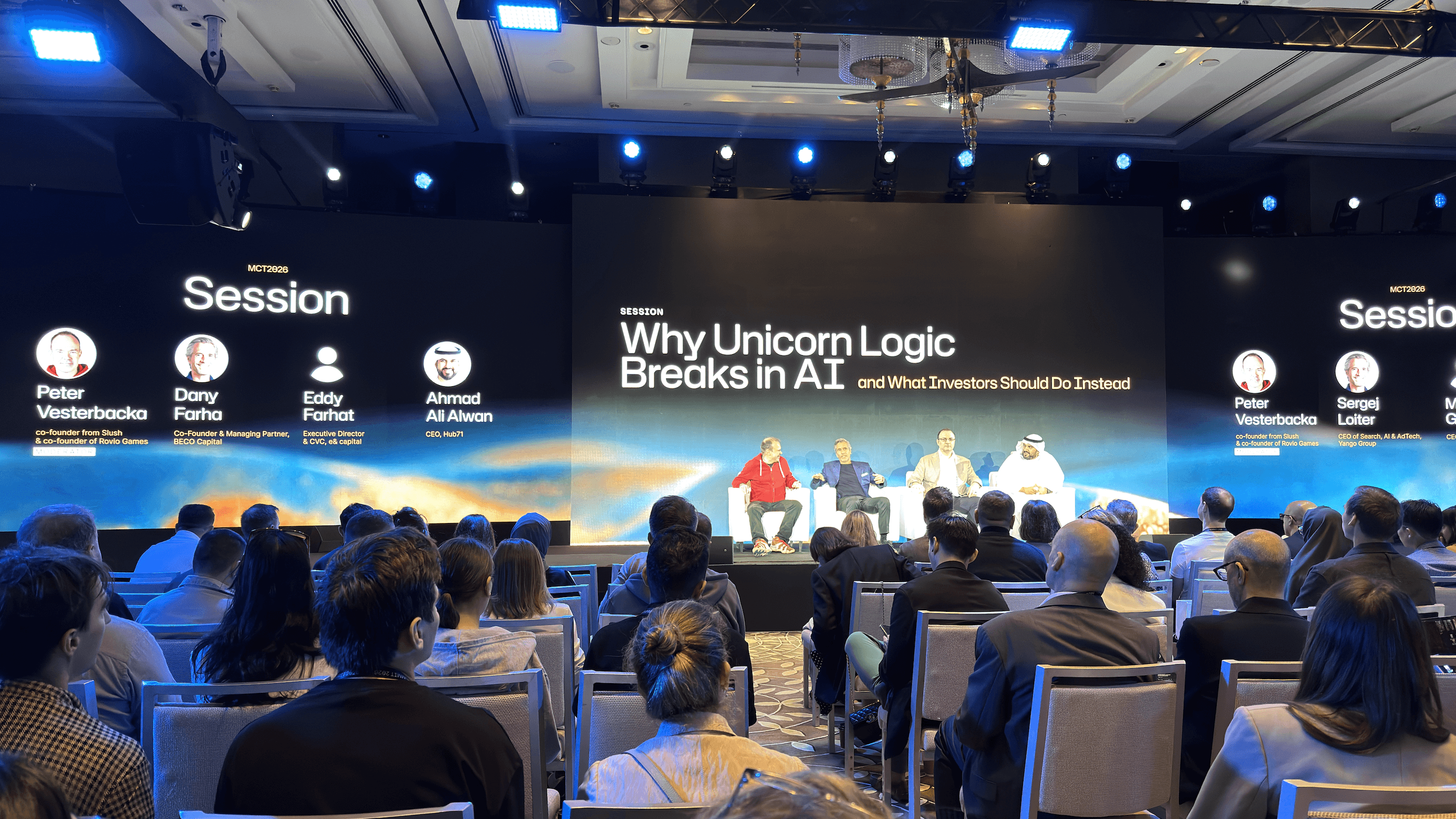
I continue to curate panel sessions from the Machines Can Think conference in Abu Dhabi at the end of January this year that are genuinely substantive and relevant to my work in Vinden.one and beyond. My current applied interests sit at the intersection of investments and AI, so the session Why Unicorn Logic Breaks in AI — and What Investors Should Do Instead was an obvious choice. The panel featured:
Peter Vesterbacka — Co-founder of Rovio (Angry Birds), Slush
Dany Farha — Co-founder and Managing Partner, BECO Capital
Eddy Farhat — Executive Director / Corporate Venture Capital, e& capital
Ahmad Ali Alwan — CEO, Hub71
Below are the key takeaways from the session.
Unicorns increasingly mean speed and revenue with micro-teams, not headcount scale
One of the key threads of the discussion was that new AI companies can reach hundreds of millions in revenue very quickly while remaining extremely small in terms of team size. Scaling is becoming less about the traditional model of “growth equals hiring” and more about “growth equals product and engineering architecture.”
Alongside this, an important observation was shared by an investor about founders in their portfolio: if many of them were starting their companies today, with the current set of tools and knowledge, they would build their businesses with roughly half the team size.
Logic shift: scale is no longer about headcount, but about speed of product delivery, quality of iteration, and the ability to grow without linear increases in people.
Too much money becomes a risk rather than an advantage
A surprisingly blunt idea was voiced: the worst thing that can happen to a startup is to raise too much money. Capital abundance makes it easier to justify inefficiency: “fat” processes emerge, unnecessary structures appear, and the company loses forced precision and discipline.
In contrast, the logic of forced efficiency was discussed: when resources are limited, teams are compelled to build more economically and with stronger engineering rigor.
Logic shift: capital stops being an automatic accelerator. In the AI era, it can easily turn into a lubricant for weak engineering and poor decisions.
The center of gravity shifts from “science and wow-technology” to engineering and product
A critical inflection point of the panel was the idea that we are moving from a phase of “looking at what impressive technology can do” to a phase where engineering and product are what truly matter.
In an AI context, this means that the winners are not those who simply “plug in a large model,” but those who design systems that are compute-efficient, quality-controlled, resilient in everyday business operations, and suitable for real-world use, including security and regulatory requirements.
Logic shift: winning is no longer about “the most powerful AI,” but about a properly engineered product that turns AI into a functioning value-creation mechanism.
The moat shifts: memory, agents, model routing, and localization
One of the most practically useful parts of the discussion was that defensive moats in AI products are increasingly less about simple access to large language models and more about how the system is designed.
Memory becomes a source of efficiency: if a system has to “think from scratch” every time, even a very intelligent one will waste resources. Agent execution adds value not only through answers but through the ability to carry actions to completion. Request routing allows simple tasks to be handled by lightweight solutions and complex ones by heavier models. Localization (on-device or within an organizational perimeter) becomes important due to cost, privacy, data sensitivity, and security requirements.
This changes the economics: growth in usage does not have to imply proportional cost growth. With the right architecture, marginal costs can decrease while value accumulates.
Logic shift: the moat is created not by the “model,” but by architecture: memory + context + agents + routing + localization.
Data and “AI embedded into operations” become key attributes of investability
For investors in the AI era, two signals are becoming increasingly critical: speed of shipping and iteration — the ability to release and update products quickly based on real data — and data that compounds business value, combined with AI being embedded into the company’s regular operational workflow, not as an experiment or add-on but as part of the everyday operational fabric.
Logic shift: investors are not investing in “AI features,” but in companies where AI + data + processes create a compounding competitive advantage.
The investor layer map: where you can play when the “top” is closed and the “bottom” is already occupied
The panel clearly described the reality for regional early-stage investors: at the hardware and infrastructure level (GPUs, robotics, supply chains), opportunities are too distant and rarely early-stage; at the foundation model level, entry is expensive and inaccessible to most traditional funds; at the application layer, strong category leaders have already emerged in the U.S., rapidly capturing markets and raising massive rounds.
This creates the need to identify your own zone of play — what can realistically be built and won at an early stage, in a region, while the global race is already running at full speed.
Regulated industries become more attractive — but through specialization and control
Another important shift discussed was that early generations of large models pushed many teams away from regulated industries due to high risks of errors and quality issues. Today, the “right” strategy for these markets looks different: less generality, more domain specialization, smaller models that “know one thing” and behave reliably, and architectures that minimize unpredictability.
Logic shift: in regulated segments, value is created not by maximum power, but by control, specialization, and robustness.
Ecosystems are back in focus: compute, universities, regulatory access
A strong part of the discussion focused on how, in the AI era, the environment begins to matter more: compute becomes a scarcity more important than capital; universities and research institutions become sources of talent and technology; regulatory accessibility and speed of navigation through the system become real competitive advantages.
This directly affects both companies and investment dynamics: where it is easier to build, test, comply, and attract strong talent.
Teams may get smaller, but founder resilience is irreplaceable
A blunt question from the audience captured the tension: if teams are partially replaced by AI systems, what becomes the primary evaluation criterion?
The panel’s practical answer was that the founder’s role becomes even more important: resilience, internal energy and “stubborn optimism,” the ability to assemble the right people as the company grows, and the capacity to sustain a long journey.
Logic shift: AI reduces the need for team “mass,” but amplifies the importance of founder character and leadership strength.
In summary — what exactly breaks in unicorn logic
Team size is no longer a proxy for scale — small teams can generate massive revenue quickly.
Capital abundance becomes a source of inefficiency — money no longer guarantees leadership.
Product engineering wins — memory, agents, model routing, localization, and quality control.
Defensive moats are built on data and operational AI integration, not on model usage alone.
Environment (compute / talent / regulator) becomes part of the success equation, especially for regions that aim to be builders rather than consumer markets.