AI Is No Longer a Technology. It Is a New Layer Between Us and Reality
AI is evolving from a standalone technology into an intelligent layer embedded within individuals, businesses, and urban infrastructure. Insights from Machines Can Think 2026 explore AI adoption, trust, localization, scalability, governance, and how artificial intelligence is reshaping business models, city systems, and digital interfaces.

Sergei Andriiashkin
Founder and Strategy Partner
AI
/
Feb 11, 2026
I continue reviewing my notes and transcripts from Machines Can Think 2026, and it becomes increasingly clear that the conversation around AI has moved far beyond “tools” and “models.” What we are witnessing is a discussion about the architecture of the environment in which we live and work.
For us at Vinden.one, this is particularly important. We work with business leaders and their teams on designing new services, entering new markets, and transforming business models. If AI is becoming an infrastructural layer, then the very logic of how we design businesses must change.
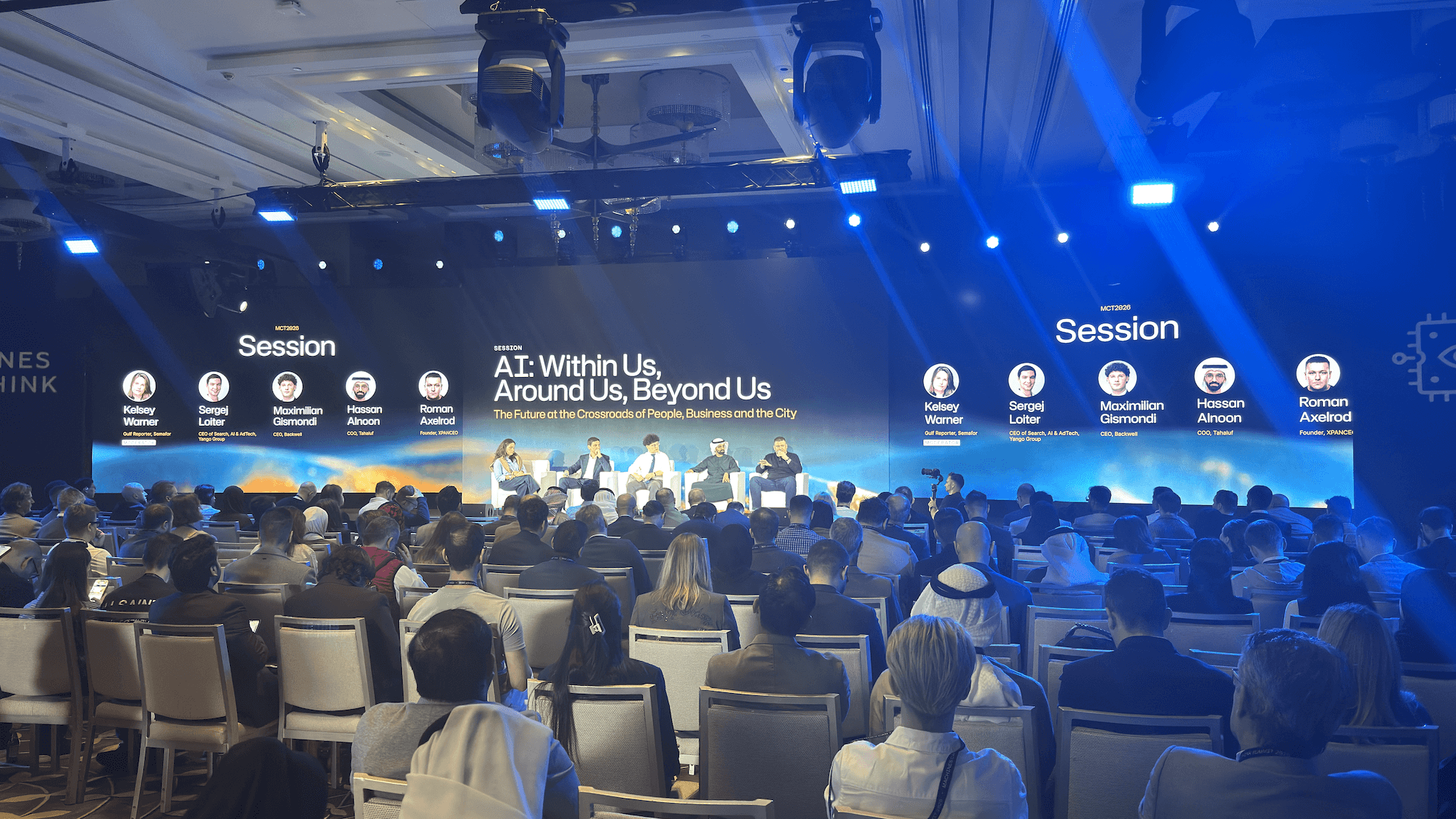
Below are the key threads from the panel “AI: Within Us, Around Us, Beyond Us — The Future at the Crossroads of People, Business and the City,” featuring Kelsey Warner (Gulf Reporter, Semafor) as moderator, Sergej Loiter (CEO of Search, AI and AdTech, Yango Group), Maximilian Gismondi (CEO, Backwelltech), Hassan Alnoon (COO, Tahaluf), and Roman Axelrod (Founder, XPANCEO).
AI as an Intelligent Layer, Not a Device
One of the central ideas expressed during the discussion was that the current generation of computing is not about a new gadget, but about what was described as “an intelligent layer between us and content and apps.” The conversation was not about replacing smartphones or competing form factors. As one speaker noted, “Laptops didn’t fight PCs,” and “Mobile phones did not fight laptops.” Devices do not eliminate their predecessors; they gradually occupy new use cases.
The underlying logic is that use cases define interfaces, not the other way around. In this context, a rhetorical question was raised: “Could you imagine using ChatGPT like 5 years ago?” The implication is clear: when new ways of interacting with intelligence emerge, new access formats follow—whether through AR, wearables, or other evolving interfaces.
Trust as the Foundation of Adoption
A significant part of the discussion focused on adoption. The message was direct: “you need to build trust.” Without trust, deployment stalls. Participants also acknowledged that negative narratives around AI complicate public acceptance.
In business contexts, trust is closely tied to transparency. It was explicitly stated that “a lot of algorithm and architectures are black boxes.” When systems are opaque, confidence declines. This makes explainability a structural requirement, not a cosmetic addition. Responsibility was also emphasized: “the parties involved in the process are responsible.” The UAE was mentioned as an example of a working model, where open dialogue coexists with clear accountability requirements.
Scale Is Architecture, Not Just Technology
Scaling AI was discussed as a systemic challenge rather than a purely technical one. The critical question, participants noted, is what specific problem is being solved. Scale is not merely about cloud capacity. It is about the ability to “connect the procedures with the front end… with the AI.”
Several speakers highlighted that companies often allocate the majority of their budgets to algorithms while underinvesting in operational and architectural design. A cautionary note was added: “most of it is on paper… then you try to test and it doesn’t fit.” In other words, systems that are architected theoretically without real-world validation often fail during implementation. Scalability must be designed into the structure from the outset.
Localization as a Condition for Growth
Localization emerged as a decisive theme. It was stated clearly: “it’s extremely important to localize your product while using the global technology.” Even if the technology is global, the product must reflect local context.
An example shared during the discussion involved partnering with local comedians to ensure a smart assistant had culturally relevant humor. Features were also adapted to regional specifics, including Ramadan. Localization, therefore, was presented not as optional refinement, but as a prerequisite for successful scaling.
This logic resonates beyond the panel itself. Recent reporting in Semafor described discussions between OpenAI and G42 regarding a localized version of ChatGPT adapted to Arabic language and cultural context—an example that reinforces the same structural necessity.
AI in Urban and Government Infrastructure
The discussion extended into public infrastructure. The importance of data centralization was emphasized: “first of all to centralize the data.” There was also reference to digital identification systems that were “built over the last 8 to 10 years” and are now being extended to other countries.
This positions AI not only within consumer interfaces, but within government and city-level systems, where coordination, procedural integration, and accountability are fundamental.
AI in Daily Life: The Beginning, Not the End
When asked whether AI has already reached everyday life, responses were measured. One participant noted that “it is solving a lot of my daily problems… improving my efficiency.” AI is already delivering practical value. Yet this was immediately tempered by the recognition that “it’s just the beginning.”
Another important point was that success is not about scale of data, but about correctness of application: “the right thing done, not a lot of data.” Finally, it was emphasized that countries must “adopt what comes from outside in the right way,” meaning that implementation must respect local culture and context rather than replicate external solutions mechanically.
Conclusion
The panel did not indulge in futuristic speculation. Instead, it focused on the operational realities of deployment: trust, architecture, localization, scaling, and responsibility. The overarching theme was consistent: AI is developing simultaneously within individuals, around them in infrastructure, and beyond traditional interfaces.
Several clear takeaways emerged:
AI is not a device, but an intelligent layer between people and content.
New use cases shape new interfaces.
Trust and transparency are critical to adoption.
Localization is necessary for global technologies to scale.
Architecture and procedures are as important as algorithms.
Government AI systems require centralized data and distributed responsibility.
AI already improves efficiency, yet participants describe the current stage as the beginning.
The discussion made one point evident: AI is already embedded in daily life and infrastructure, but it remains in an early phase. Trust, architectural design, and cultural adaptation will determine what this new layer between humans and reality ultimately becomes.