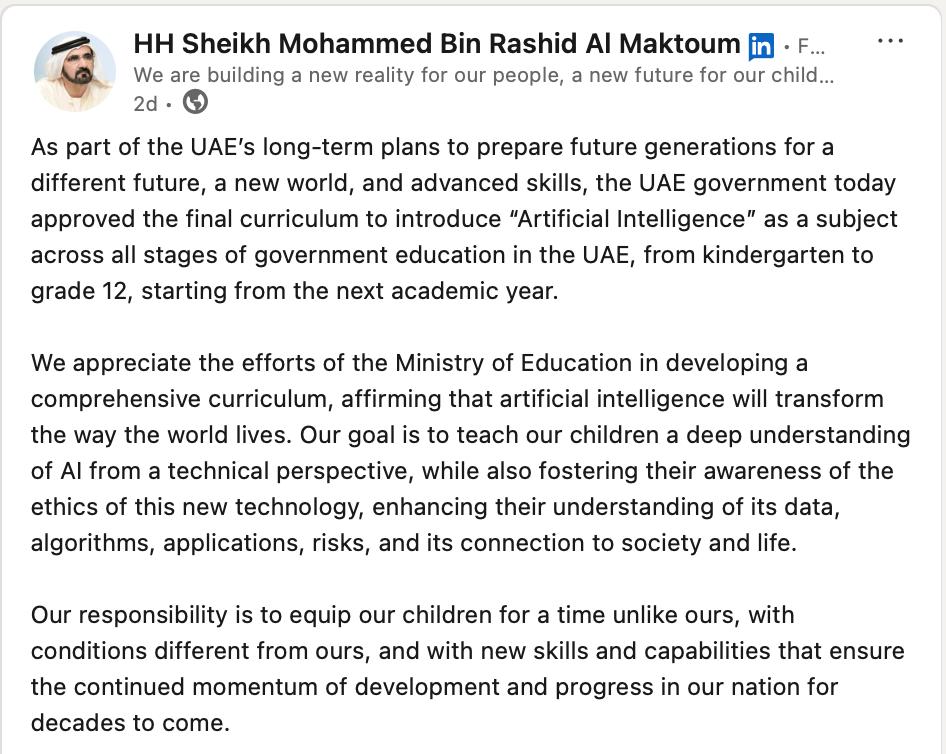
In just one year, the UAE is not only acknowledging a profound shift but also acting on it.
AI is being integrated into how children grow up: not only through technology but also through discussions on ethics, data, algorithms, risks, and their connection to life and society.

Sergei Andriiashkin
Founder and Strategy Partner
Education
/
May 7, 2025
It’s hard to overstate how fast AI has progressed in the past 18 months — and how deeply it’s already woven into our lives. For our children, it’s no longer just a tool. It’s gradually becoming part of how they learn, play, think — and how they imagine their future careers.
Education systems around the world are usually slow to change. By nature, they are cautious – built to preserve stability. That’s why the decision by HH Sheikh Mohammed bin Rashid Al Maktoum and the UAE government to introduce AI into the national curriculum from kindergarten to grade 12 is so remarkable.
In just one year, the UAE is not only acknowledging a profound shift but also acting on it. AI is being integrated into how children grow up: not only through technology but also through discussions on ethics, data, algorithms, risks, and their connection to life and society. This is more than curriculum reform—it’s a wise and timely response to a world already transformed.
Previous generations grew up computer-first or mobile-first. But this next generation — the children now 3 to 5 years old — will be AI-native. For them, AI won’t be an innovation; it will be the environment they grow up in.
We don’t know exactly what skills will matter most in 10 or 15 years — the pace of change is too fast. But we can help children make sense of the present: approach this new reality with curiosity, clarity, and critical thinking.
A bold, thoughtful, and respectful step by the UAE — and a global benchmark for future-ready education.