Key Partners — a Structural Part of Strategy
Key partners aren’t about convenience — they’re about necessity. It’s the “otherwise it won’t work” part of your strategy. These are the people or companies that have what you don’t — resources without which executing your strategy would be either extremely difficult or outright impossible.

Sergei Andriiashkin
Founder and Strategy Partner
Partnerships
/
Oct 17, 2025
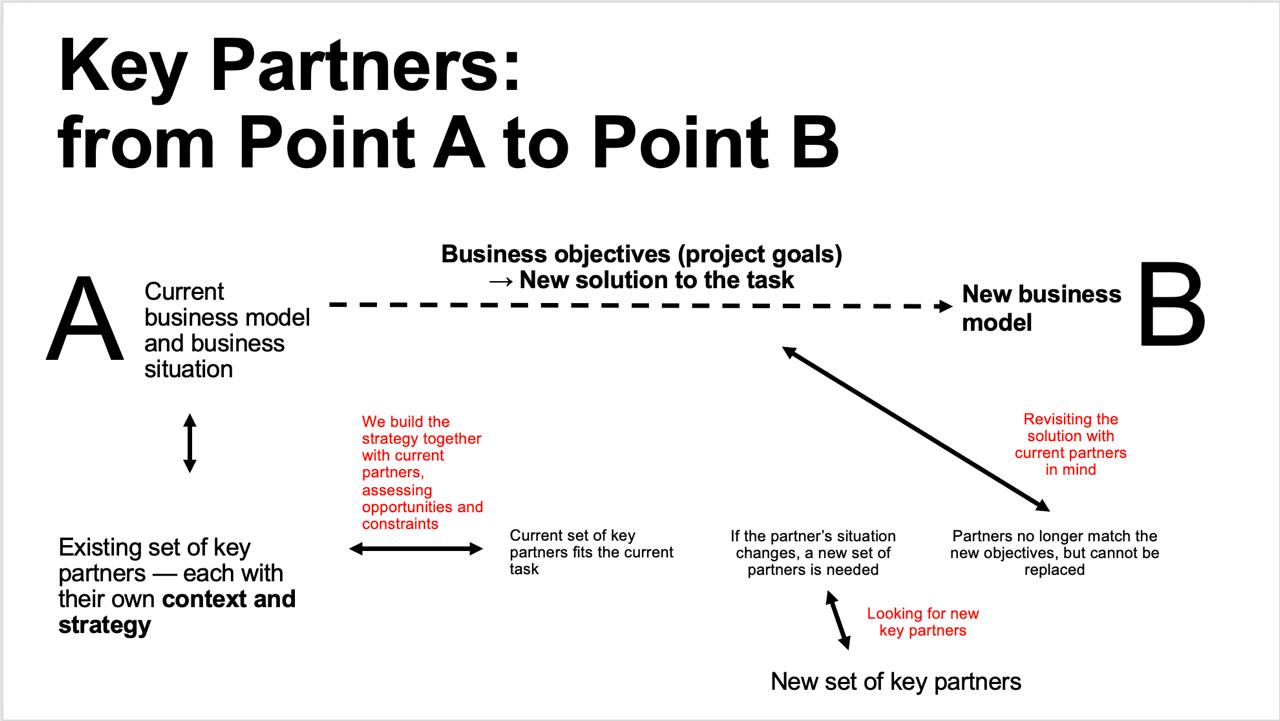
In Alexander Osterwalder’s Business Model Canvas, often used to describe business concepts, there’s a block called Key Partners. Yet, it’s one of the most overlooked elements — overshadowed by the more visible blocks like Value Proposition, Customer Segments, or Revenue Streams. And that’s a mistake. Key partners aren’t about convenience — they’re about necessity. It’s the “otherwise it won’t work” part of your strategy. These are the people or companies that have what you don’t — resources without which executing your strategy would be either extremely difficult or outright impossible. Sometimes it’s access to customers or sales channels, sometimes it’s market trust, a brand, infrastructure, licenses, or teams you wouldn’t be able to build in time. And sometimes, it’s simply a different way of thinking that you don’t yet have.
In my professional practice, I’ve seen this many times. Tele2 and Telenor, two strong competitors in the European telecom market, joined forces to build and launch one of the world’s first 4G networks. A similar story happened between Tele2 and Telia Sonera — a 3G network partnership that allowed both companies to provide better coverage and quality while cutting CAPEX almost in half. The launch of Evotor, beyond its strong idea and capable team, was powered by a partnership with ATOL, whose industry expertise, technologies, and partner network made the product possible. The launch of Fortis, a retailtech company in the UAE, was built on partnership with Network International, the region’s largest payment provider, which delivered not just the payment infrastructure but also access to a client base.
But such partnerships always come with both advantages and risks. On one side — investment, brand leverage, access to markets, technology, distribution, expertise, and influence. On the other — dependency, reputation risks, conflicts of interest, and potential technology capture. Lawrence Levy described this tension perfectly in To Pixar and Beyond: Pixar relied on Disney’s marketing powerhouse, but the deal limited its independence and growth potential. The story of Pixar, as told by Levy, is essentially a story about redefining a strategic partnership.
When we design strategies at Vinden.one, we always ask a simple question: who are the partners critical to your model? If there’s no clear answer — that’s a blind spot. No strong system is built alone. Fast growth rarely happens without tapping into someone else’s power — their distribution, trust, expertise, licenses, or capital.
It might seem like “key partners” is a concept for large corporations, but it’s not. In my course at the British Higher School of Art and Design, we explore partnership strategies, their types, benefits, risks, and ways of building them. And we see that partnerships can drive growth not only for big brands — but just as much for startups and small businesses.